
Article: What Kosher Pareve Chocolate Actually Means at a Holiday Table

What Kosher Pareve Chocolate Actually Means at a Holiday Table
At a holiday table, dessert is rarely just dessert.
It arrives after the plates have been cleared, after somebody has opened a second bottle, and usually after at least one relative has asked a question that should have waited until January. Dessert is the moment when everyone comes back together.
It is also the moment when dietary details matter. If you are hosting friends or family who keep kosher, the word pareve can make the final course much easier. But it is one of those useful little words that is often repeated without being properly explained.
So, what does kosher pareve chocolate actually mean, and why is it such an elegant thing to serve at a holiday table?
First, what does pareve mean?
In kosher food practice, pareve describes food that contains neither meat nor dairy. A pareve food can generally accompany either a meat meal or a dairy meal, provided the food, its preparation, and its certification meet kosher requirements.
Chocolate is not automatically pareve. Many chocolates contain milk, butterfat, whey, or other dairy ingredients. Even a dark chocolate with no obvious dairy ingredients may be produced on equipment used for dairy products. This is why the certification on the package matters.
The simplest rule for a host is also the least glamorous: read the label. Look for a trusted kosher certification and confirm that the product is marked pareve. A beautiful box is important. A beautiful box that answers the practical question before anybody has to ask is better.

Why it matters at a holiday table
A kosher pareve dessert gives a host flexibility. If dinner includes meat, a pareve chocolate can offer a refined finish without introducing dairy. If the meal is dairy, it still belongs. This does not replace the care required in a kosher kitchen, but it can remove one complication from the menu.
More importantly, it lets hospitality feel natural.
No guest wants to become the evening’s dietary announcement. Thoughtful hosting means doing a little work quietly, then allowing everyone to enjoy the same generous gesture. The box can be opened in the center of the table. People choose what intrigues them.
“For me, luxury begins when nobody has to explain why they can or cannot eat something. The host has already thought about it, and the pleasure can simply begin.”
Pareve and vegan are not the same thing
They often overlap, but the words describe different standards.
Vegan food contains no animal-derived ingredients. Pareve food contains neither meat nor dairy according to kosher law, but it is not necessarily vegan. Eggs and fish, for example, can be pareve. A product may be vegan without being kosher-certified, and a product may be kosher pareve without being vegan.
If you are serving guests who care about both, check both claims. Maison Noten chocolates are created to bring these considerations together, with the richness and detail expected from fine French chocolate. The point is not to make a “good alternative.” The point is to make genuinely good chocolate that happens to welcome more people to the table.
What fine chocolate should bring to the occasion
Once the practical details are settled, we can return to the serious matter: pleasure.
A holiday chocolate should offer contrast. Something deep and roasted. Something bright with fruit. Something silky, perhaps with a little salt or a crisp finish. The assortment should create conversation without requiring a speech from the host.
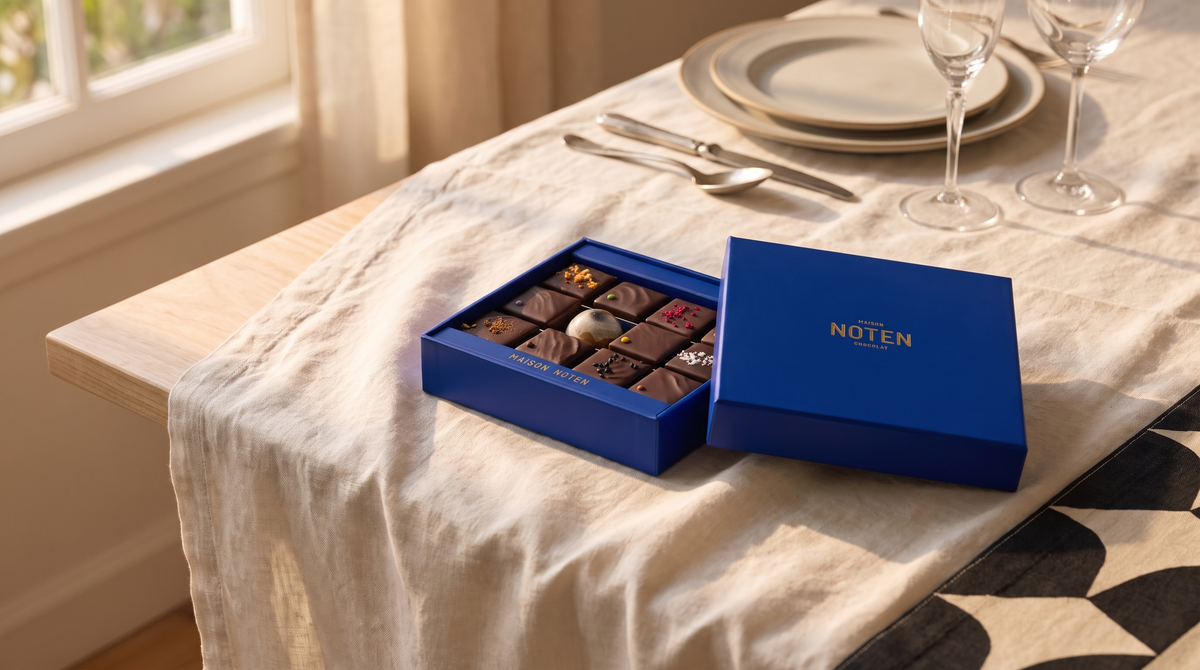
We prefer to serve chocolates after dinner with coffee, tea, or a small glass of something festive. Place the open box where everyone can reach it. There is no need for elaborate plating. Good chocolate does not need parsley, powdered sugar, or a small architectural accident built beside it.
One or two pieces per person is the polite calculation. Real life will require more.
“We are French, so we believe dessert should feel effortless after an unreasonable amount of effort. The guest should only see the beautiful box and wonder which chocolate to steal first.”
A simple guide for the host
- Check the certification. Look for a recognized kosher symbol and confirm that the chocolate is identified as pareve.
- Keep the packaging. Guests may want to verify the certification or ingredients themselves, and the original box makes that easy.
- Use a clean serving piece. If you transfer the chocolates, be mindful of the kitchen, utensils, and surfaces involved.
- Ask discreetly when needed. Kosher observance varies. A thoughtful private question is always better than an assumption.
- Serve enough. This is not technically a matter of kosher law, but we consider it essential.
The most meaningful gift is one that can be opened
A box of kosher pareve chocolate is especially useful when you are not completely certain what the host will be serving. It can join a meat meal or a dairy meal, travel beautifully, and be shared immediately. For holiday dinners, Shabbat invitations, thank-you gifts, and the very Los Angeles art of arriving “casually” with something impeccable, it is a small object with excellent social instincts.
The best gifts do not create work. They create a moment.
Bring the box. Let the host decide whether to open it after dinner or hide it for tomorrow. Both are respectable choices. We are chocolatiers, not detectives.
What matters is that the gesture feels generous, considered, and delicious. That is the entire idea behind Maison Noten, and, we think, the beginning of a very good table.

Leave a comment
This site is protected by hCaptcha and the hCaptcha Privacy Policy and Terms of Service apply.